



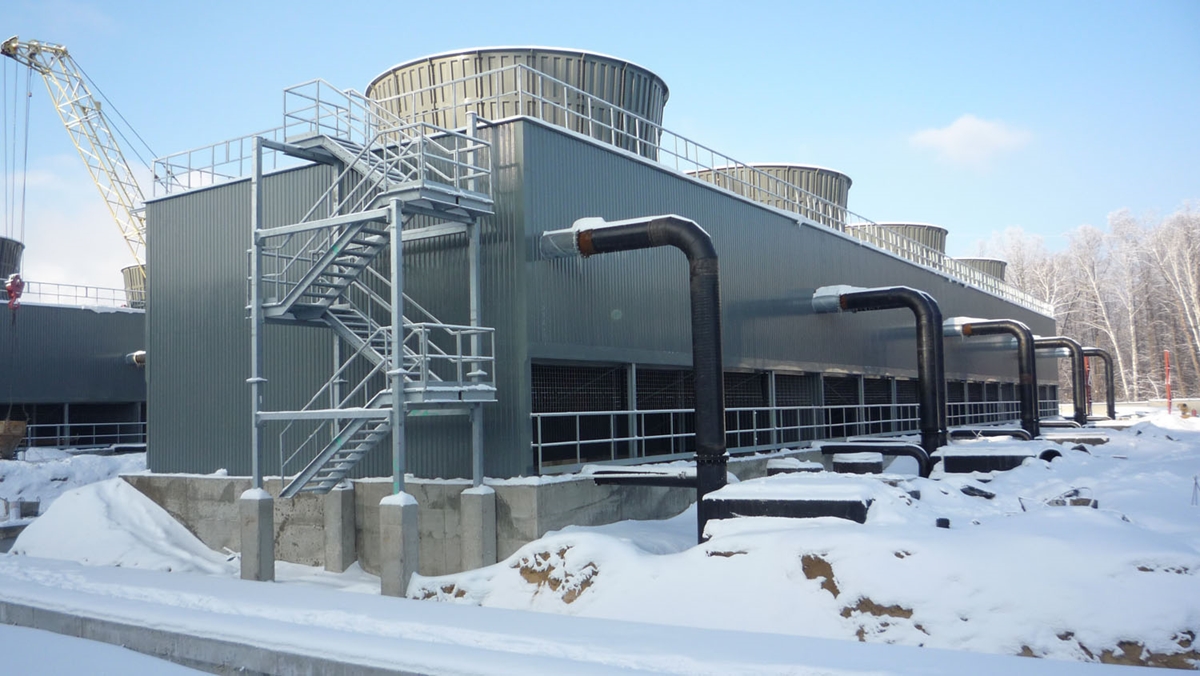
Cooling towers keep countless systems running in the background of modern industries. You’ll see them supporting manufacturing lines, chemical plants, food processing, power generation, and even massive HVAC systems for hospitals and high-rise buildings.
Any system that generates more heat than it can release on its own relies on a cooling tower to move that heat out.
Among the different tower designs, the induced draft cooling tower has earned a strong reputation because of its efficient airflow and stable thermal performance. It’s a common choice for modern facilities and one of the most reliable setups in real-world conditions.
If your work touches HVAC, facility operations, maintenance, or process engineering, understanding how these towers function can help you troubleshoot problems, make smarter upgrade decisions, manage energy use, and keep the full system performing the way it should.
In this post, we break down how induced draft cooling towers work, step by step.
What Makes an Induced Draft Cooling Tower Different?
A cooling tower’s main job is to remove heat by evaporating water. But the way the tower handles airflow is what separates the different designs.
There are two common categories of mechanical draft cooling towers:
- Forced draft towers: The fan pushes air into the system from the base.
- Induced draft towers: The fan pulls air upward through the tower and exhausts it from the top.
An induced draft system uses a large fan at the discharge point to draw air evenly through the fill media before releasing it through the top. Essentially, this setup creates steady airflow, reduces recirculation problems, and maintains consistent evaporation.
Many facility engineers prefer induced draft systems because they’re more stable in variable weather, load swings, and seasonal humidity changes.
Airflow: The Core Principle Behind the System
An induced draft cooling tower works by accelerating air movement from the bottom openings through the interior section (known as the fill) and out the top.
Here’s the airflow path breakdown:
- Ambient air enters the tower through side louvers or lower openings.
- The air travels upward through the fill material.
- Water droplets meet the airflow, releasing heat and evaporating moisture.
- The warm, moist air exits the top through the fan exhaust.
Because the fan sits at the top and pulls air upward, the movement draws air evenly. There are fewer stagnant areas, and the entire heat exchange process becomes more predictable.
Step-by-Step Breakdown of Cooling Operation
To understand how an induced draft cooling tower works, it helps to break the process down into a clear flow. The cooling cycle isn’t complicated once you see how each part contributes.
Step 1: Hot Water Arrives from the System
Water that has absorbed heat from equipment, chillers, or process operations enters the cooling tower through a pipe at the top.
Step 2: Water Distribution
The tower sprays the incoming warm water over the fill section. A pressurized spray system or gravity-fed distribution deck spreads water evenly, so it contacts as much air as possible.
Step 3: Heat Transfer Inside the Fill Media
The fill is a structured surface made of PVC or other moisture-resistant material. It increases the contact area between air and water. The larger the surface area, the better the evaporation.
There are two common fill types:
- Film fill: Water spreads into thin layers over surfaces.
- Splash fill: Water breaks into droplets as it moves downward.
Most modern induced cooling tower systems use film fill because it supports better cooling efficiency and lower energy use.
Step 4: Evaporation Removes Heat
As air passes through the wet fill, a portion of the water evaporates. The evaporation process absorbs heat from the remaining water, lowering its temperature.
Step 5: The Fan Pulls Air Upward
The high-efficiency fan draws air through the system and exhausts it through the top stack. Since the fan pulls instead of pushes, the airflow is more controlled and uniform.
Step 6: Cooled Water Returns to Service
After passing through the fill, the cooled water collects at the bottom basin and is pumped back to the facility’s system to repeat the cycle.
Why is the Top-Mounted Fan Significant?
The position of the fan changes how the airflow behaves.
Placing the fan at the top creates a low-pressure zone inside the tower. The suction effect improves:
- Airflow stability
- Thermal performance
- Tower efficiency
- Resistance to wind influence
Also, recirculation is one of the biggest losses in poorly designed towers. Because the fan in an induced draft cooling tower pushes warmed exhaust air upward and away from the inlets, the system avoids pulling warm air back into the structure.
Benefits of an Induced Draft Cooling Tower
Induced draft cooling towers are used across industries because they work efficiently under real-world conditions. Here’s a closer look at why many facilities prefer them over older or more basic tower types.
Better Airflow Control
Because the fan is mounted at the top of the tower, it pulls air through the system instead of pushing it in. You don’t get dead spots or uneven cooling like you might with forced draft designs. Consistent airflow allows the tower to perform more predictably, which is exactly what you want when managing heat loads across a large system.
Stable Cooling During Load Swings
Every facility faces changing demands, such as seasonal temperature swings, fluctuating production levels, or HVAC usage patterns. Induced draft towers are known for staying stable under all of them.
Even when the flow rates or outside temperatures shift, the system maintains steady evaporation and heat transfer. This stability is important for processes reliant on constant temperatures, like chemical production or data center cooling.
Better Heat Rejection
The combination of top-down airflow, even water distribution, and well-designed fill gives these towers a thermal edge. They’re able to cool water more effectively, with less wasted energy.
Better Performance in Warm or Humid Climates
In hot or humid regions, cooling towers are already working against high ambient temperatures and thick air. Forced draft systems can struggle under these conditions.
Induced draft towers, on the other hand, tend to tackle humidity and heat better thanks to their high exhaust elevation and strong airflow control. They also reduce the chance of warm exhaust air hanging around the system.
Easier Maintenance Access
With the fan and motor assembly located at the top of the unit, it’s typically easier to inspect and maintain these components without disturbing the water distribution system. Many modern towers are designed with walkways or access ladders.
Adaptability for Modern Systems
Induced draft towers are more compatible with automation tools and modern cooling tower services. You can tie them into building management systems (BMS), set up remote monitoring, or optimize them with temperature and humidity sensors. These upgrades help operations teams track performance and respond to issues faster.
Bringing the Concept Full Circle
Induced draft cooling towers are one of the most dependable ways to remove heat from industrial processes and central building systems. They operate on a combination of airflow control, evaporation, and steady water circulation.
Whether you’re evaluating a new installation, comparing mechanical draft designs, or upgrading equipment through professional cooling tower services, having a clear understanding of how these systems operate supports better decisions and long-term reliability.